AI Agent

















The problem
Your store is fine. The conversation in front of it is not.
Shoppers no longer start by browsing your product page. They start with a post, an ad, or a story, and they send you a private message before they even open your website. "Do you have this in Black?","Is this real leather?" The store answers none of that but a person does, hours later.
So you install a chatbot. It follows a certain script, it cannot see stock or the prices changed last week and the first time someone asks about a variant it either invents an answer or apologises and asks them to email support system. Both outcomes end the sale before it even begins.
Meanwhile the actual product data lives in Shopify or WooCommerce, one system away from the conversation where the purchase decision is being made.
An AI agent for ecommerce is only worth deploying if it can see your catalog. Everything else is a chatbot with better copywriting.
What it costs
The gap between the question and the answer is where the margin lies
You already paid to create the demand. The ad ran, the creative campaign was successful, and the shopper showed interest. What happens in the next few minutes determine whether this investment turns into an order or into a competitor’s order.
And the cost is not linear. A manual DM operation works efficiently at thirty conversations a day but it gradually breaks down at three hundred which is precisely the day your best campaign lands.
Answers that arrive too late
A shopper deciding between you and two other tabs does not wait until the morning shift.
Recommendations nobody makes
No one suggests the larger size, an alternative when your preferred product is out of stock or the restocked colour, so average order value stays flat.
Carts abandoned between chat and checkout
Every external link in the conversation to a checkout page is another place to lose the buyer.
Ad spend attributed to nothing
Sales close inside a chat, so no browser pixel fires and Meta only ever sees "a message received".
The better version
One shopper, start to finish, without a human touching it
Nothing changes about your products or your pricing. What changes is that the conversation itself becomes an operator that knows your catalog.
21:35
A shopper replies to an Instagram story asking whether a product available in black.
21:37
The agent checks the synced catalog, confirms the variant is in stock, and sends the product image.
21:39
She asks about delivery fees. It answers from your stated policies, in her own language.
21:41
She commits. The order is created inside the chat and pushed to your store, and the lead moves to Converted.
Next day
A different shopper went quiet after a price question. One guarded follow-up goes out once, and never if he already ordered.
The solution
What an AI agent for ecommerce should actually do
Unifunl connects to your store WooCommerce, Shopify, PrestaShop, Magento, Odoo, Salla, Converty, or a custom store through the Unifunl Commerce API and syncs products, prices, variants and stock automatically. Once a product is indexed, the agent can recommend it. If it is not indexed, it does not exist for the agent, which is what stops invented stock.
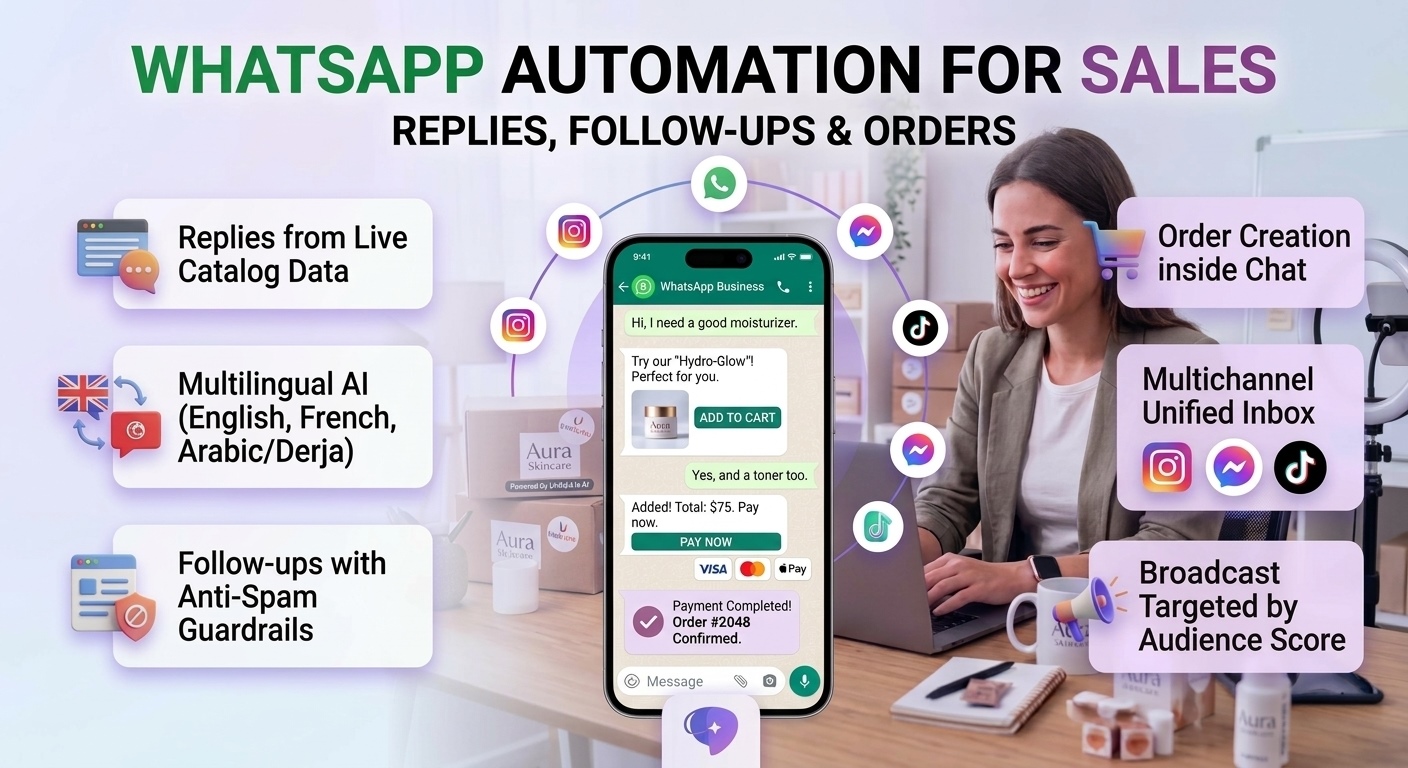
The same agent runs on every channel where your shoppers already are: WhatsApp , Instagram DM, Facebook Messenger, TikTok DM and your website widget, all in one inbox with the context carried across them.
You brief it the way you would brief a new employee, store details, active promotions, delivery and return policies, persona, tone, languages, explicit rules about “what to always do” and “what to avoid at all costs, and the cases that must escalate to a human. Set it up manually, or just describe the changes to Copilot and confirm .

How it works
How to set up an AI agent for your ecommerce store in about fifteen minutes
Connect your store
WooCommerce, Shopify, PrestaShop, Magento, Odoo, Salla, Converty or a custom store .
Check the catalog is indexed
A product must show status Indexed before the agent will recommend it.
Connect your channels
WhatsApp, Instagram, Facebook Messenger, TikTok and the website widget, all feeding a single inbox.
Brief the agent
Store info, promotions, delivery and return policies, persona, tone, languages and escalation rules.
Test before going live
Live Test lets you message the agent with text, image or voice exactly as a shopper would, before it ever replies to a real customer.
Switch it on and set the follow-up
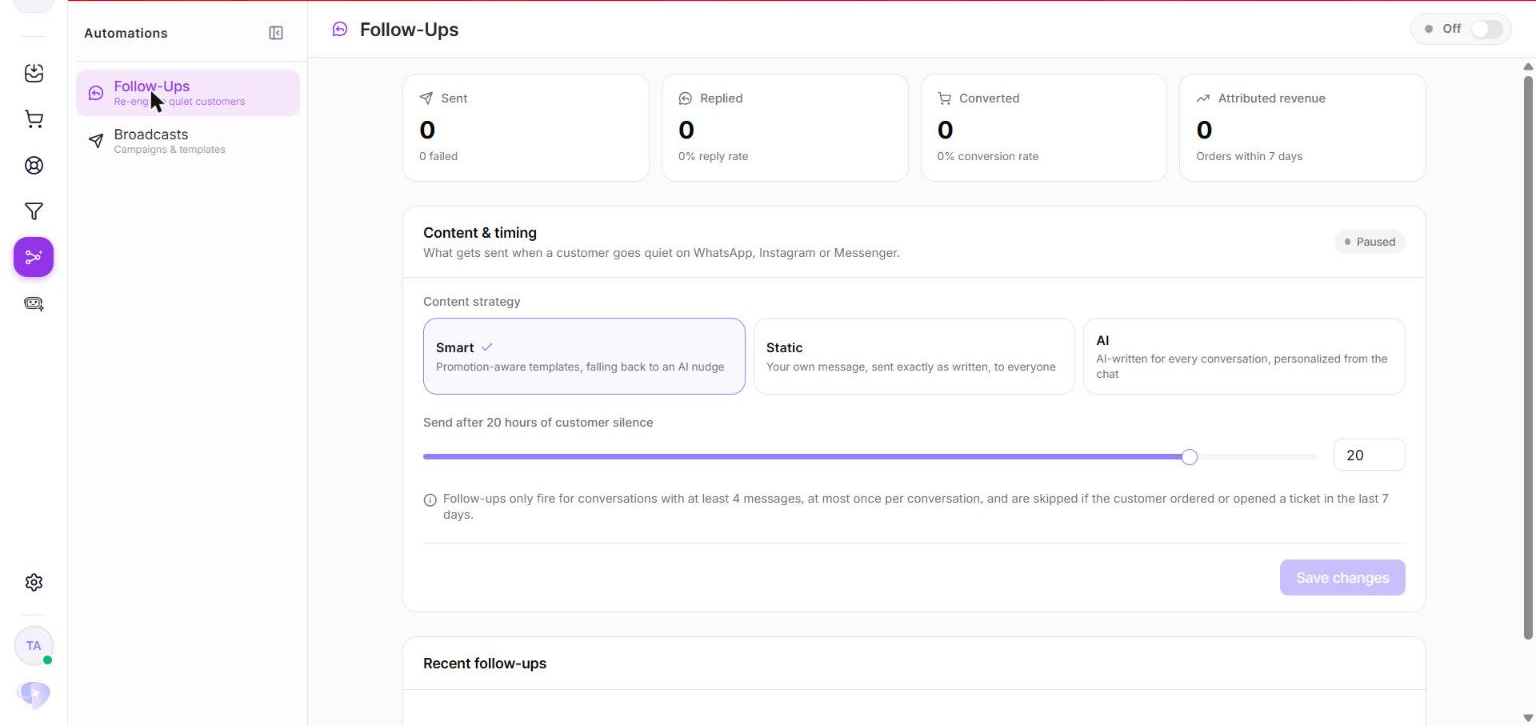
Toggle Active, invite your team, then pick a follow-up strategy and silence window.

Capabilities and impact
What an ecommerce AI agent changes in the business
01Answers grounded in your live catalog
Prices, variants and stock come from your synced store data, not from a saved reply or a scripted data.
No invented stock, no wrong price, no product that does not exist.
02Orders created in the conversation
When the buyer commits, the order is created in the chat and pushed to your connected store.
No external link sent, and no cart abandoned between the DM and the checkout page.
03Every contact scored automatically
Contacts move from New to Warm, Hot and Converted as intent builds, with lead stats pushed to your CRM.
Your team works the hottest buyers first, and campaign audiences build themselves.
04Guarded follow-ups on silent buyers
A follow-up fires only on conversations with at least four messages, at most once, and never if the customer ordered or opened a ticket in the last 7 days.
You recover quiet conversations without becoming the brand people block.
05Sells in your customers’ language
English, French, Arabic, Tunisian Derja, Moroccan and Algerian, in Latin or Arabic script, including mixed-language messages.
Shoppers write the way they always have, and still get a correct answer.
06Ad spend attributed to real purchases
The Meta Conversions API integration sends a server-side Purchase event with the amount whenever the agent records an order.
Meta optimises on actual sales instead of on "message received".
07Handoff without switching the agent off
AI Autopilot is per conversation, so a human takes one chat while the agent keeps running everywhere else. Angry customers, refunds, disputes and high-value orders escalate on rules you set.
Automation handles the volume, your team makes the decision.
Proof
Ecommerce brands already running the conversation on an AI agent
These are Unifunl customers whose DMs are handled by an AI agent trained on their own catalog. Each story explains what changed operationally, not just the headline number.
40%
Conversion rate on DMs
I’m no longer thinking about hiring new salespeople. We grew orders 30% and conversion is at 40%, with 70% less agents.
Brazilian Glow
Siwar — CS Director, Brazilian Glow
Read the story+30%
Average order value
The AI now replies like a real product advisor in under a minute, converts 30–40% of DMs and lifted our average order by 30%.
SF Nutrition
Operations, SF Nutrition
Read the story100+
Orders a day through DMs
We doubled our sales going from 0 to 100+ orders a day — just through DMs, with no new hire. The AI replies in under 2 minutes.
WeePops
Founder, WeePops
Read the storyWhy this and not an ecommerce chatbot or AI Helpdesk
Most ecommerce AI is built to deflect tickets, not to sell
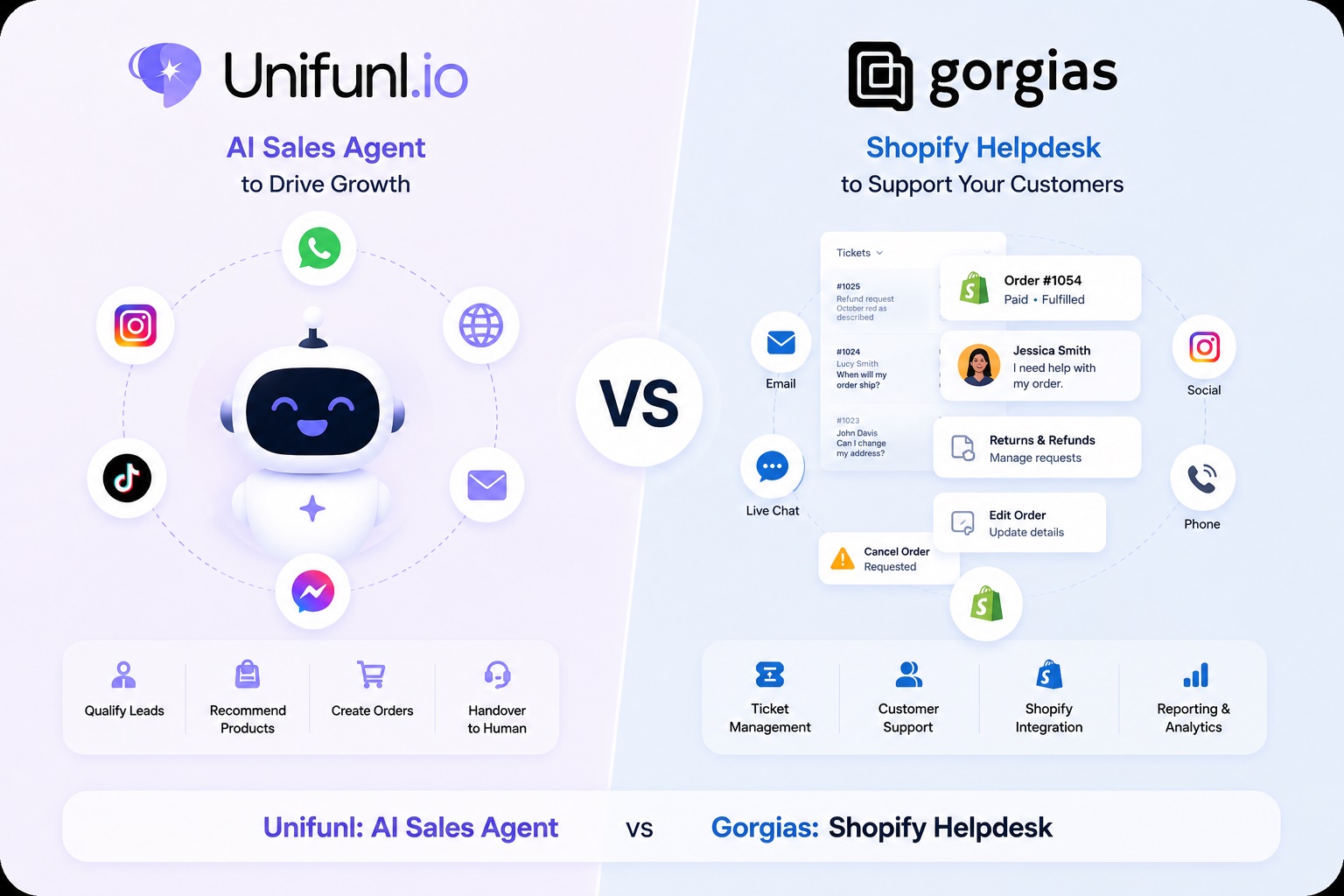
A helpdesk AI is measured on how many conversations it closes without a human. That is a support metric. It is perfectly rational for it to end a conversation, and perfectly useless for a conversation with intent to buy.
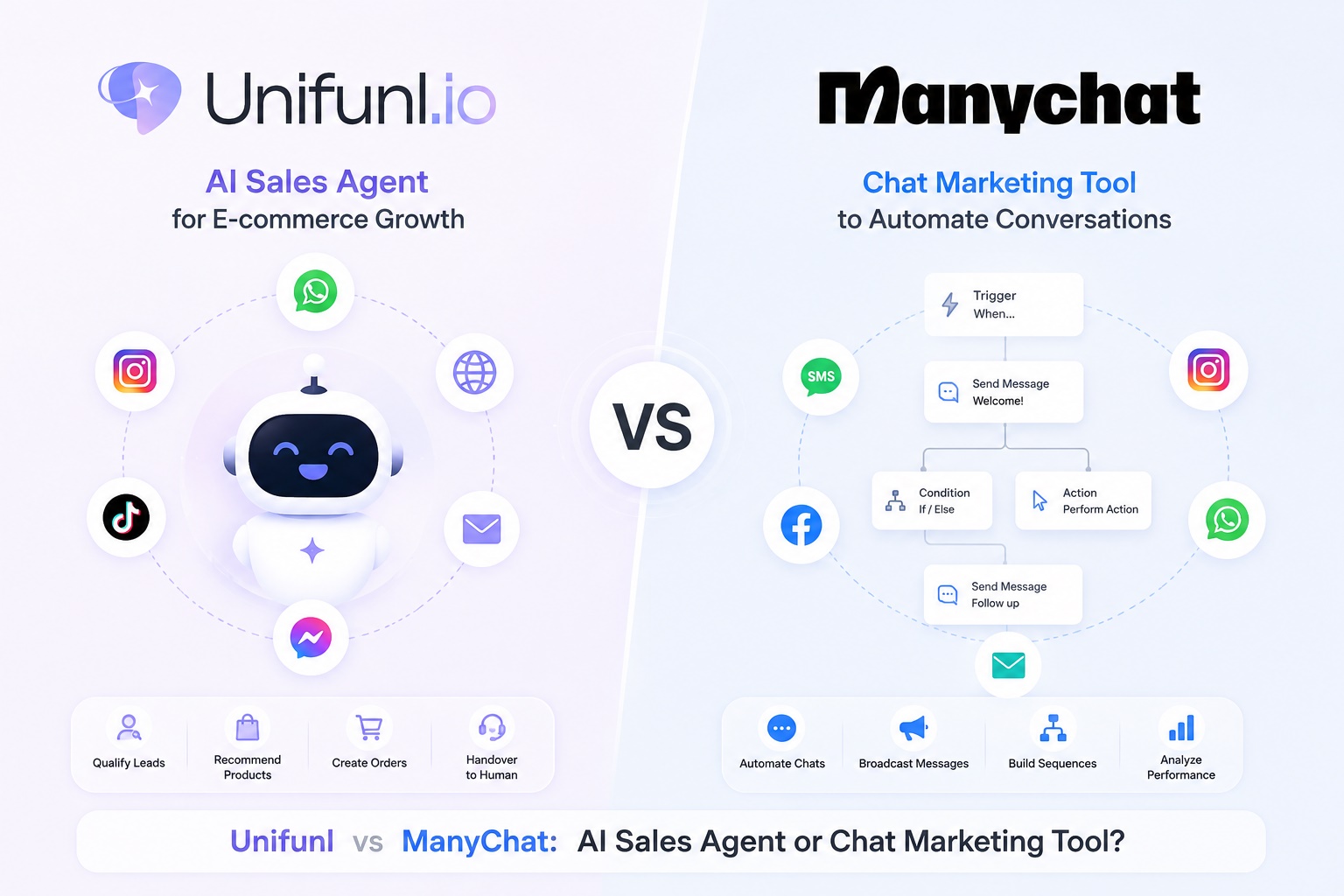
A chatbot is the opposite problem, the moment a shopper asks something outside the script, a person has to step in.
Unifunl is built for the intent to buy. It doesn't hand off when a shopper goes off-script or escalate to a human the moment things get complex. Instead, it reasons over live catalog data, creates the order and reports the revenue it produced.
Chatbots and helpdesk AI
- Optimised for deflection and ticket closure
- Answers from scripted articles, not from live stock
- It focuses on the conversation not on the sale
- Reports resolution rate, not revenue
Unifunl ecommerce AI agent
- Optimised for completed orders
- Answers from your synced catalog and policies
- Creates the order inside the conversation
- Reports orders, AOV and attributed revenue
Measurement
An agent you can put a number on
Order analytics reports revenue, average order value, completion and cancellation rate, change over time and a product ranking, exportable as a PDF.
Follow-ups report Sent, Replied, Converted and attributed revenue , so re-engagement is a line item rather than a feeling.
The Stats page reports conversations, generated orders, average credits per conversation and average credits per order, which turns "is the agent worth it?" into cost per completed order instead of cost per seat.