AI Agent














Unifunl vs Wati: what happens after she replies?
You send the campaign. Meta approves the template. It goes out to 2,000 contacts.
Ninety of them reply.
That moment is where the two platforms separate. Not the sending, both do that, both use the same Meta-approved templates, both wait the same fifteen minutes for approval. The difference is the next sixty seconds, when ninety people are asking ninety versions of "c'est combien?", "vous avez en 38?", "mawjoud fi noir?", and someone has to answer every one of them from your actual stock.
Wati routes those ninety replies to your team.
Unifunl answers them, checks the live catalog, sends the photo, and creates the order in the thread.
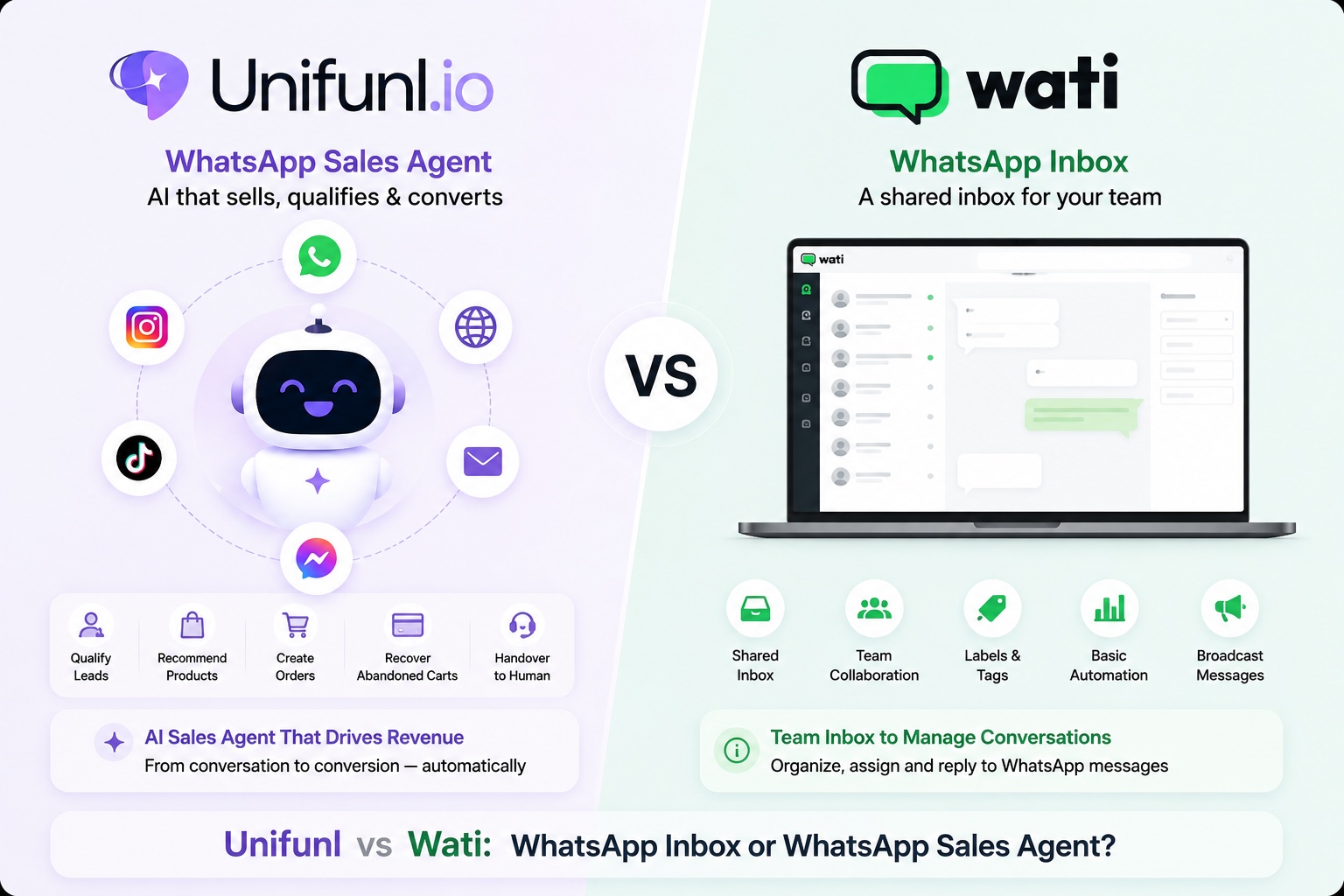
Wati is a WhatsApp Business API inbox your team operates. Unifunl is an AI sales agent that runs the WhatsApp conversation through to the order.
What is Wati?
Wati is a WhatsApp Business API platform built around a shared team inbox and broadcast campaigns.
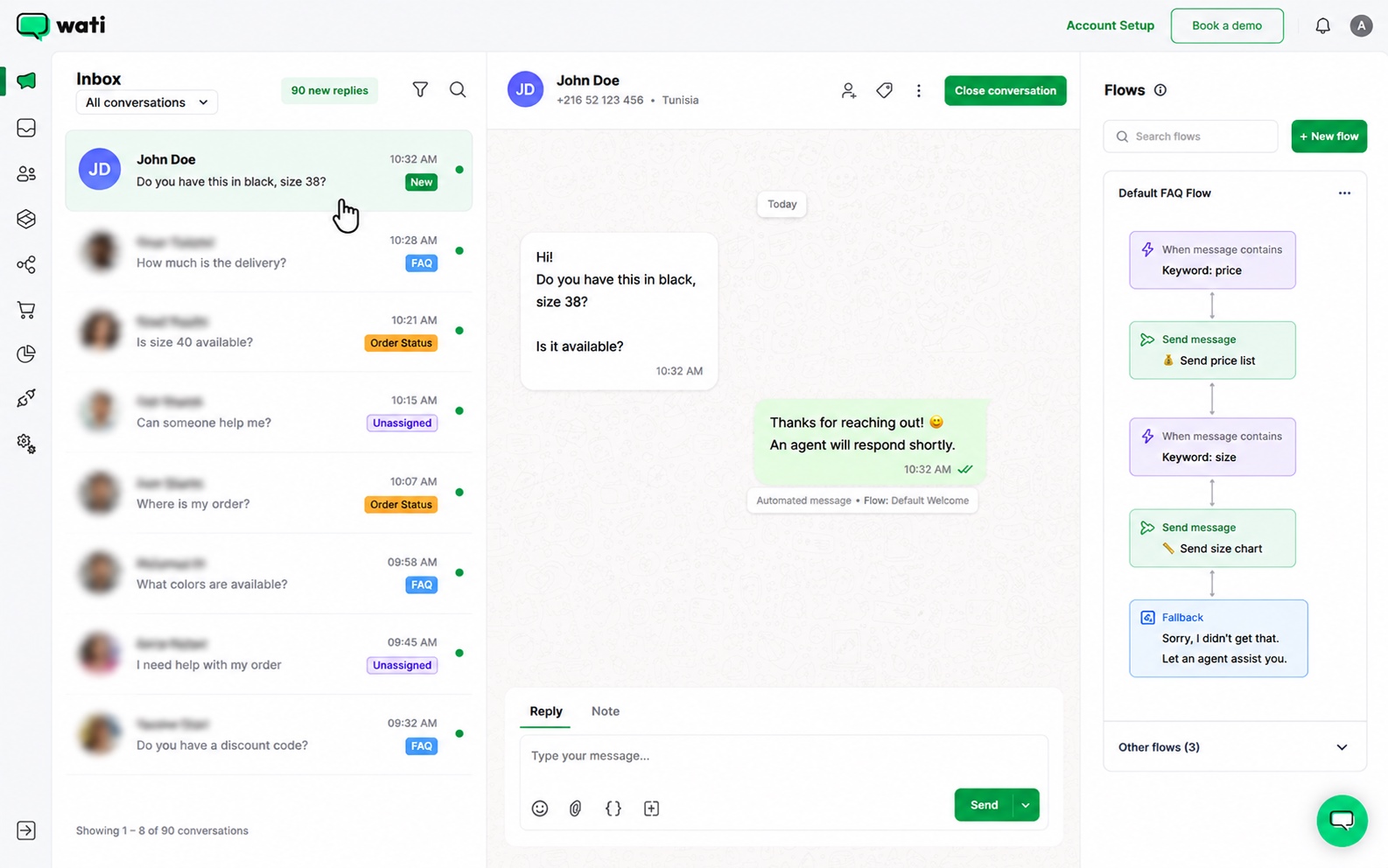
Choose Wati when the requirement is WhatsApp access with a team workflow: an official API number, a shared inbox with agent assignment and labels, broadcast lists, and no-code chatbot flows built from keyword triggers and branching steps. It is well established in MENA, India and Southeast Asia, and for a team that mainly needs organised WhatsApp messaging it does that job at an accessible price.
The constraint is scope. Wati is WhatsApp-first by design, and its automation is flow-shaped: you define the paths in advance. That works cleanly for FAQs, order status and structured menus. It gets harder when the answer depends on live stock, when the customer asks about three products at once, or when the conversation should end in an order rather than a handoff.
What is Unifunl?
Unifunl is an AI sales agent for businesses that sell in DMs, with WhatsApp as its primary channel.
Use Unifunl when WhatsApp is where you actually sell, not just where you reply. The agent answers from indexed catalog data, sends product images, creates the order inside the conversation and syncs it to your store, re-engages buyers who go quiet, and reports the revenue those conversations produced.
It runs on the WhatsApp Business Platform with the same official footing as any other provider: link an existing WhatsApp Business account or register a fresh number, use Meta-approved templates for business-initiated messages, and operate within Meta's daily messaging limits.
It also works in English, French, Arabic, Tunisian Derja, Moroccan and Algerian, in Latin or Arabic script, including messages that switch language mid-sentence. And the same agent runs on Instagram, Messenger, TikTok DM and a web widget with no per-channel charge, if and when you need that.
Both are WhatsApp platforms. Here's the real difference.
Let's clear up the thing most comparison pages get wrong.
Templates aren't a Wati limitation. Meta requires one for any first business message outside the 24-hour window. Unifunl uses them too: Marketing, Utility or Authentication, approved per language.
The real difference is what happens once that window opens. Wati runs the flows you pre-built: keyword triggers, branches, menus. Unifunl runs an agent that checks your synced catalog, answers what was actually asked, like "do you have this in medium?", and keeps working the sale: scoring intent, following up if the customer goes quiet, and pushing the conversation toward a close instead of just fetching a stock answer.
Unifunl vs Wati: side-by-side comparison
✅ Full support ➖ ❌ Not supported
| Feature | Unifunl | Wati |
|---|---|---|
| WhatsApp foundations | ||
| Official WhatsApp API | WhatsApp Business Platform | WhatsApp Business Platform |
| Link existing or new number | Both supported | Both supported |
| Meta-approved templates | Required for business-initiated messages, ready-made set included | Required for business-initiated messages |
| Shared team inbox | Unified across every channel | Core strength |
| Inside the conversation | ||
| Automation model | Reasoning agent grounded in your catalog | No-code flows built from keyword triggers |
| Live stock and variants | Answers from indexed products, prices, stock, variants | Depends on what the flow was built to say |
| Product images in chat | Sends product images in the thread | Possible in a flow, not chosen by an agent |
| Inbound voice notes | Understands voice notes | Not supported |
| Order creation in chat | Creates the order and syncs it to the store | Handed to a human or an external link |
| Campaigns | ||
| Broadcast campaigns | Product Offer, General Promo, Custom Template | Broadcast lists |
| In-chat checkout | WhatsApp Flow checkout with automatic discount | Typically links out to the store |
| Audience selection | Purchase-probability score, plus filters and refine controls | Contact lists, tags and manual segments |
| Campaign reporting | Through to Replied and Converted | Delivery and engagement metrics |
| After the conversation | ||
| Silence-window follow-up | Configurable, with anti-spam guardrails | Not a native re-engagement engine |
| Contact scoring | New, Warm, Hot, Converted, Customer | Tags and labels set by the team |
| Revenue attribution | Revenue attributed to follow-ups within a 7-day window | Not a sales-attribution tool |
| Meta ad attribution | Server-side Purchase events via the Meta Conversions API | Not offered |
| Reach and language | ||
| Instagram / Messenger | Same agent, same catalog | Limited or plan-dependent |
| TikTok DM | Native channel | Not supported |
| Per-channel charge | None | Depends on plan |
| Tunisian Derja | Native, Latin or Arabic script | Not supported |
| Moroccan / Algerian | Native | Not supported |
Swipe horizontally to see the full table →
Campaigns: a list, or an audience?
Both platforms broadcast. The gap is who you send to and what the customer can do when it arrives.
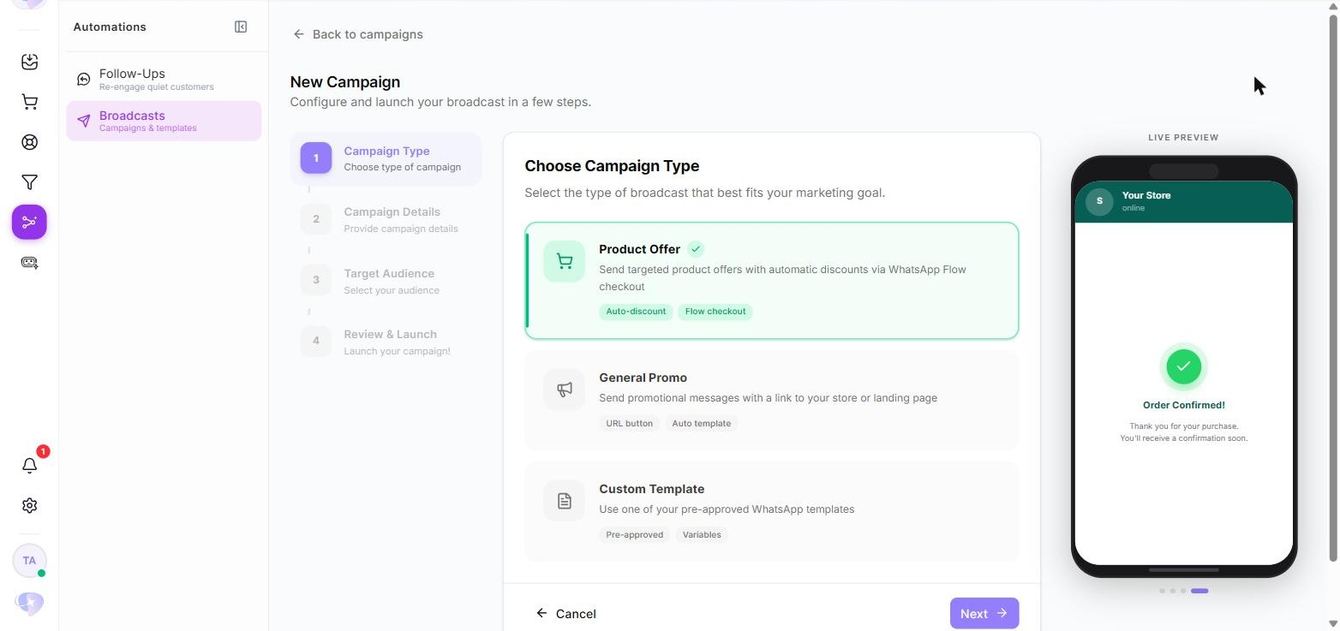
Wati sends to contact lists you segment with tags and filters. The message lands, and interested customers click through to your store.
Unifunl builds the audience from a purchase-probability score calculated from purchase history, products already discussed, past campaign engagement, and how long since the last order. You can then refine it: cap the audience size, set a minimum score, and exclude anyone contacted in the last N days.
Then there's what the message does. A Product Offer campaign carries a targeted product, an automatic discount (as a store coupon or applied directly at checkout) and an in-chat checkout through WhatsApp Flow. The customer completes the purchase without leaving the thread.
And it reports through to the end: Sent, Delivered, Failed, Read, Replied, Converted.
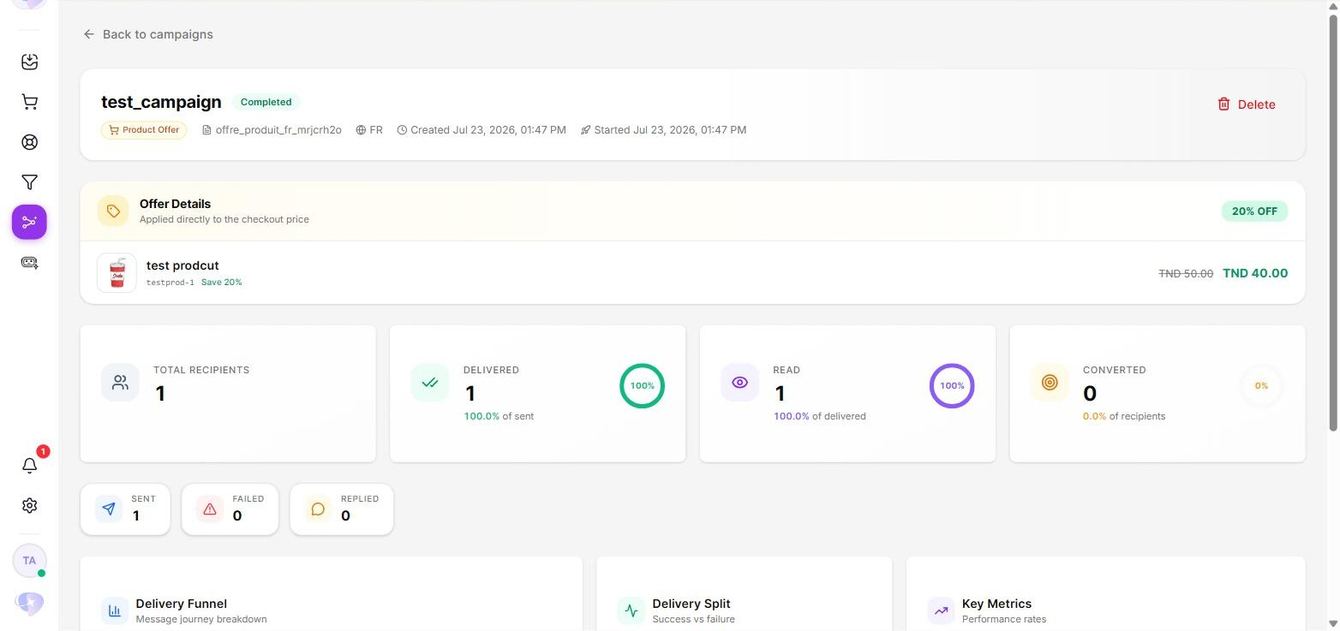
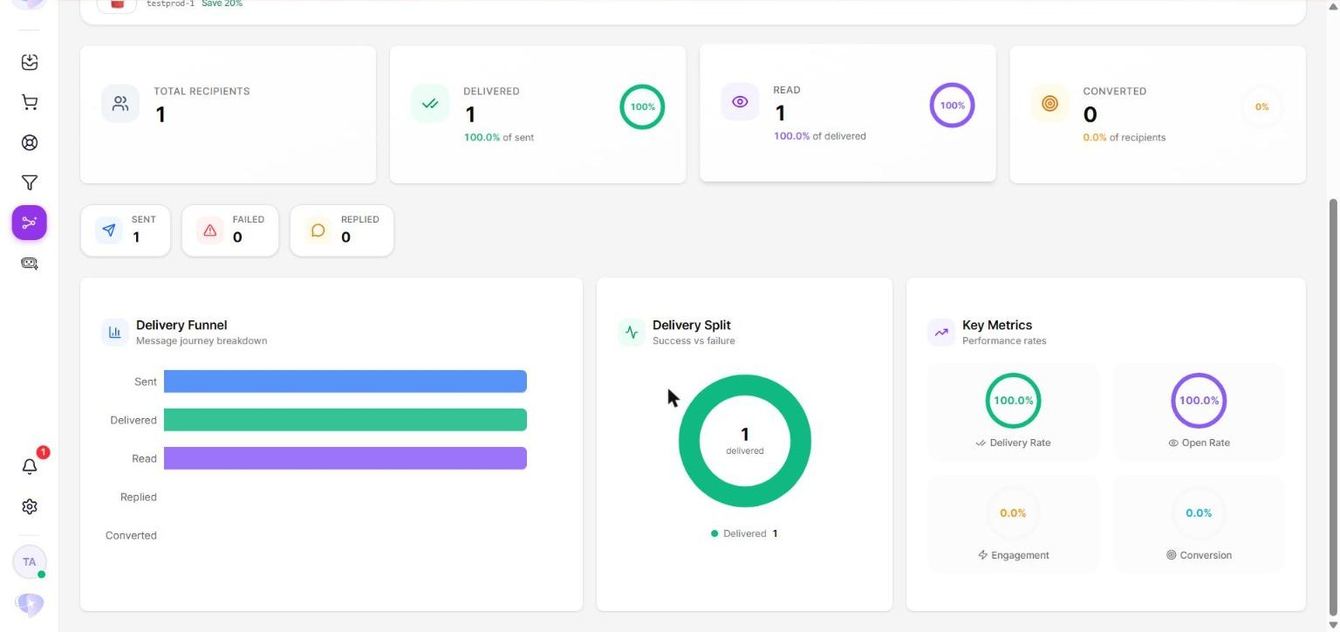
That last column is the one that tells you whether the campaign worked.
Follow-ups: the revenue nobody sends
A buyer asks about delivery. You answer. She goes quiet.
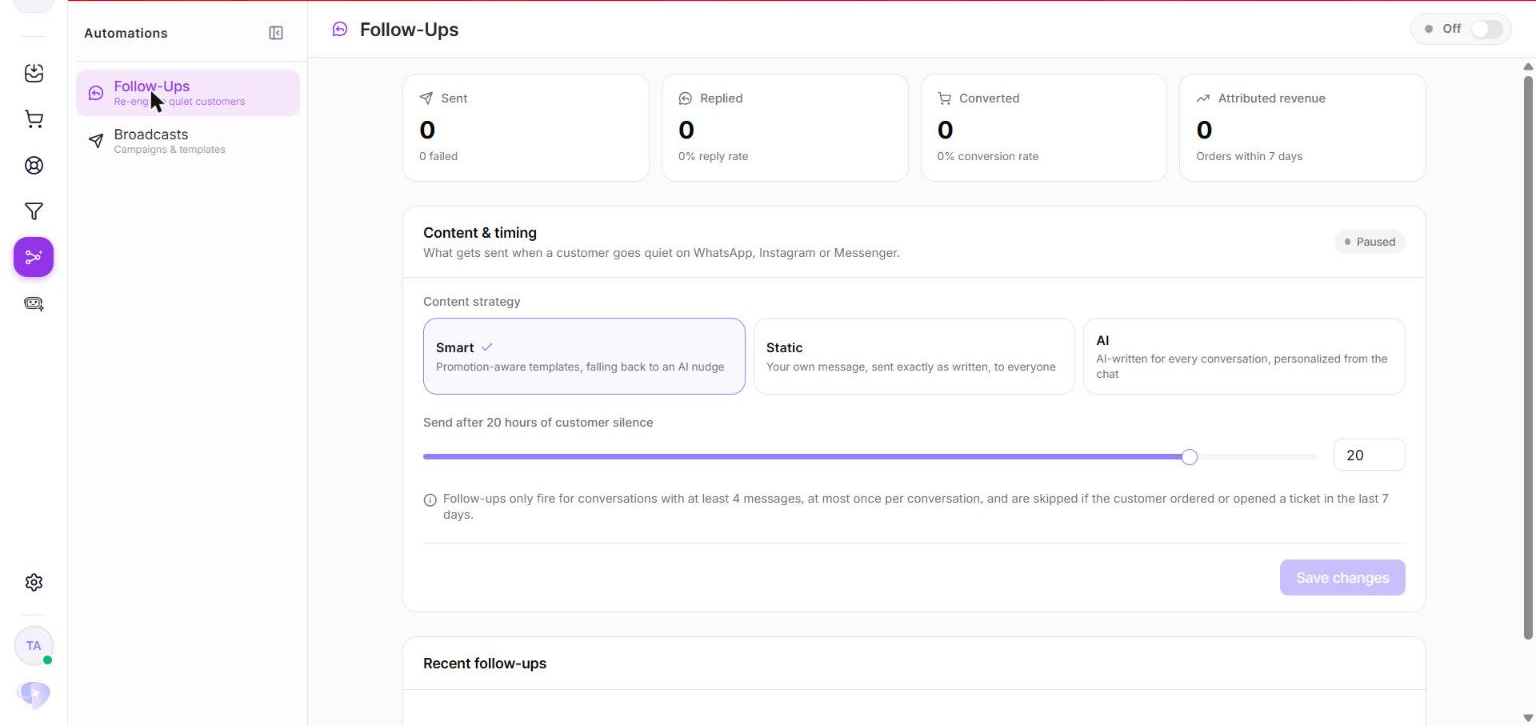
At ten conversations a week you follow up manually. At two hundred you don't, and that is silent, unmeasured lost revenue, the largest leak in most WhatsApp operations.
Unifunl sends a follow-up after a configurable silence window, around 20 hours is a sensible starting point, using one of three strategies: Smart (promotion-aware template with an AI fallback), Static (one message for everyone), or AI (written per customer from that conversation's context).
The guardrails matter as much as the trigger, because WhatsApp punishes spam with quality ratings:
- Only for conversations with at least 4 messages, so genuine exchanges, not one-word enquiries
- At most once per conversation
- Skipped entirely if the customer already ordered or opened a ticket in the last 7 days
Results are tracked as Sent, Replied, Converted, and revenue attributed to orders placed within 7 days.
Meta ad attribution: the argument nobody makes
If you run Meta ads to WhatsApp, this section is worth more than any inbox feature.
When a sale closes inside a chat, no browser pixel fires. Meta sees "a message was received" and optimises toward that: more conversations, regardless of whether any of them became an order.
Unifunl's Meta Conversions API integration sends a server-side Purchase event, with the amount, every time the agent records an order. Meta can then attribute the sale to the ad that started it and optimise for actual purchases instead of message volume. No website pixel, no code, and it is configured per connected Facebook Page or Instagram account.
For a merchant spending on click-to-WhatsApp ads, this changes what the ad platform learns from.
Language: where MENA merchants actually lose customers
Your customer writes "3andek hedha f noir?" in Derja, Latin script, with a mid-sentence switch.
Wati serves MENA, but its automation operates in standard Arabic, English and other major languages. A keyword flow does not match a message spelled a way no one standardised.
Unifunl handles English, French, Arabic, Tunisian Derja, Moroccan and Algerian, in Latin or Arabic script, including code-switching. There is a ready-made persona, Amira, built as a brand ambassador fluent in Derja, or you can configure your own tone and rules.
This is not a nice-to-have in Tunis, Casablanca or Algiers. It is the difference between an answer and a dead thread.
Where Unifunl does the work
A WhatsApp campaign to 2,000 contacts produces 90 simultaneous replies
Unifunl — Answers all 90 from live catalog data, sends product images, and creates orders in the thread.
Wati — Routes 90 conversations into the shared inbox for the team to work through.
A small team needs an official WhatsApp number, a shared inbox and simple FAQ automation on a tight budget
Wati — Exactly what Wati is for: API access, team inbox and keyword flows at a low entry price.
Unifunl — More platform than the job needs if nothing has to close in the conversation.
A customer sends a voice note in Derja asking whether an item comes in another colour
Unifunl — Understands the voice note, reads the variant data, and replies in the same dialect.
Wati — Voice notes fall outside flow automation, and Derja is not a supported language.
A merchant wants to promote one product to the contacts most likely to buy it
Unifunl — Builds the audience from purchase-probability scores and closes the sale through in-chat checkout.
Wati — Broadcasts to a tagged list, with the purchase completed off-platform.
Buyers arrive from Instagram and TikTok as well as WhatsApp
Unifunl — Same agent, same catalog and one inbox across WhatsApp, Instagram, Messenger, TikTok DM and web, with no per-channel charge.
Wati — WhatsApp-first by design, so conversations on other channels sit outside the system.
Row two is honest and it matters. If you need an official WhatsApp number and a tidy shared inbox, and nothing has to close in the conversation, Wati is the cheaper and simpler purchase.
Unifunl pricing vs Wati pricing
Wati's entry price looks cheaper, because it's selling you less. Its base plans cover WhatsApp inbox basics: API access, a shared inbox, broadcasts and flow automation, with Meta's conversation charges stacked on top. Fair pricing for what it is, but what it is, is a messaging tool. Someone on your team still has to check stock, answer questions and close the sale.
Unifunl is priced as a sales operation, because that's what it replaces. Every plan, not just the top tier, includes all channels, the unified inbox, the AI agent, broadcast campaigns, abandoned-cart follow-ups and priority support, with monthly credits tied to actual AI activity instead of per-channel fees. Six languages including Derja come standard from day one, with no enterprise upgrade required to talk to your own customers. Full plans and credit allowances are on the pricing page.
So don't compare the two on subscription cost, because they aren't buying you the same thing. The question worth asking: those ninety replies to your last campaign, how many became orders, and how many are still sitting unanswered in the inbox?
Unifunl reports average credits per order in Settings → Usage, so you can put a real number against that rather than an estimate.
Use Unifunl and Wati together?
Usually not, and that's the honest answer.
A a WhatsApp number can only be connected to one provider at a time. This isn't a Gorgias-style split where each tool owns a different room. It's a replacement decision.
Wati
WhatsApp inbox for a team
- Official WhatsApp API number with a shared team inbox
- Broadcast lists, tags and agent assignment
- No-code keyword flows for FAQs and structured menus
Unifunl
WhatsApp sales agent
- Answers from live catalog data and creates the order in the thread
- Scored campaign audiences with in-chat checkout and follow-up attribution
- Derja, Moroccan and Algerian, plus Instagram, Messenger, TikTok and web
The handoff: Choose by outcome: if WhatsApp is where your team replies, Wati is enough. If WhatsApp is where you sell, the conversation needs an agent that can close.
Frequently asked questions
Ninety replies, and a Tuesday morning
Go back to the campaign.
Two thousand messages sent, ninety replies. With Wati they are all still there on Tuesday morning, sorted and labelled and waiting for someone to work through them. Some of those people bought elsewhere on Monday night.
With Unifunl, most of them were answered in the moment, from real stock, in the customer's own dialect, with the order created in the thread, and the ones who went quiet got a follow-up you never had to remember to send.
Same campaign. Same template. Same ninety people.
Connect WhatsApp, upload your catalog, and it's live in under 24 hours. No code, no card.