وكيل الذكاء الاصطناعي











The problem
Your customers don’t write in the language your chatbot was trained on
In North Africa and across the MENA region, nobody types a DM in textbook Arabic. They write in Derja, often in Latin letters with numbers standing in for sounds (“3aslema, 9adech el prix?”). They switch to French mid-sentence, drop an English word for the product, and when typing gets tiring, they just send a voice note.
A generic multilingual chatbot is built for clean, single-language input. It runs the message through “Arabic” or “French” detection, gets neither, and replies with a menu, a fallback message or an answer in the wrong language. An Arabic chatbot trained on Modern Standard Arabic is no better: Derja is not MSA, and Arabizi is not Arabic script.
So the conversation falls back on a human who has to read, decode and reply to every single one. Which is exactly the work you bought the bot to remove.
“Supports Arabic” on a feature list tells you nothing. The only test that matters is whether the bot understands a Derja message typed in Latin letters with a French word in the middle.
What it costs
A customer who is not understood does not repeat themselves. They leave.
Language is not a nice-to-have on top of automation. For a merchant selling in Tunisia, Morocco, Algeria or across the MENA region, it decides whether automation works at all.
Fallback replies on your hottest leads
“Sorry, I didn’t understand” is the answer the shopper gets at the exact moment they asked about price or stock.
Voice notes that sit unanswered
A bot that only reads text silently ignores the customers who prefer to talk, and they are often the most ready to buy.
A team hired to translate, not to sell
Every message the bot cannot parse lands on a person, so headcount grows with volume instead of automation absorbing it.
A brand that sounds foreign to its own market
Replying in stiff MSA or formal French to a customer who wrote in casual Derja reads like a call centre, not like a local shop.
The better version
Three languages, one voice note, one order
Nothing about the way your customers write has to change. The agent adapts to them, message by message.
22:10
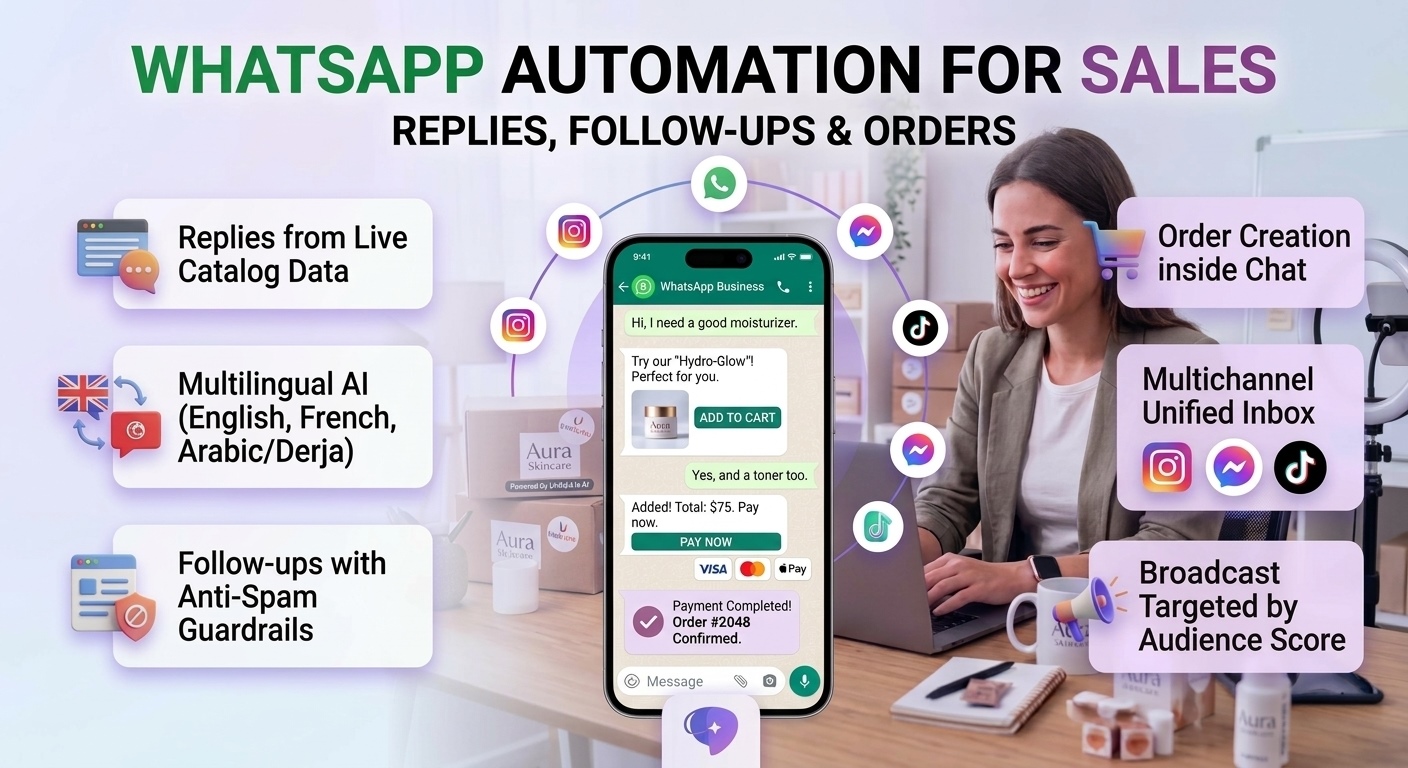
A shopper writes on Instagram: “Salam, 3andkom el serum hedha? 9adech?” — Derja, Latin letters, numbers for sounds.
22:11
The agent checks the synced catalog and replies in Derja, with the price and the product image.
22:13
She sends a voice note asking about delivery to Sfax. The agent understands it and answers from your delivery policy.
22:15
She switches to French to confirm her address. The agent follows her into French and creates the order in the chat.
Next morning
A different customer writes in English from abroad. Same agent, same catalog, answered in English.
The solution
What a multilingual AI agent should actually understand
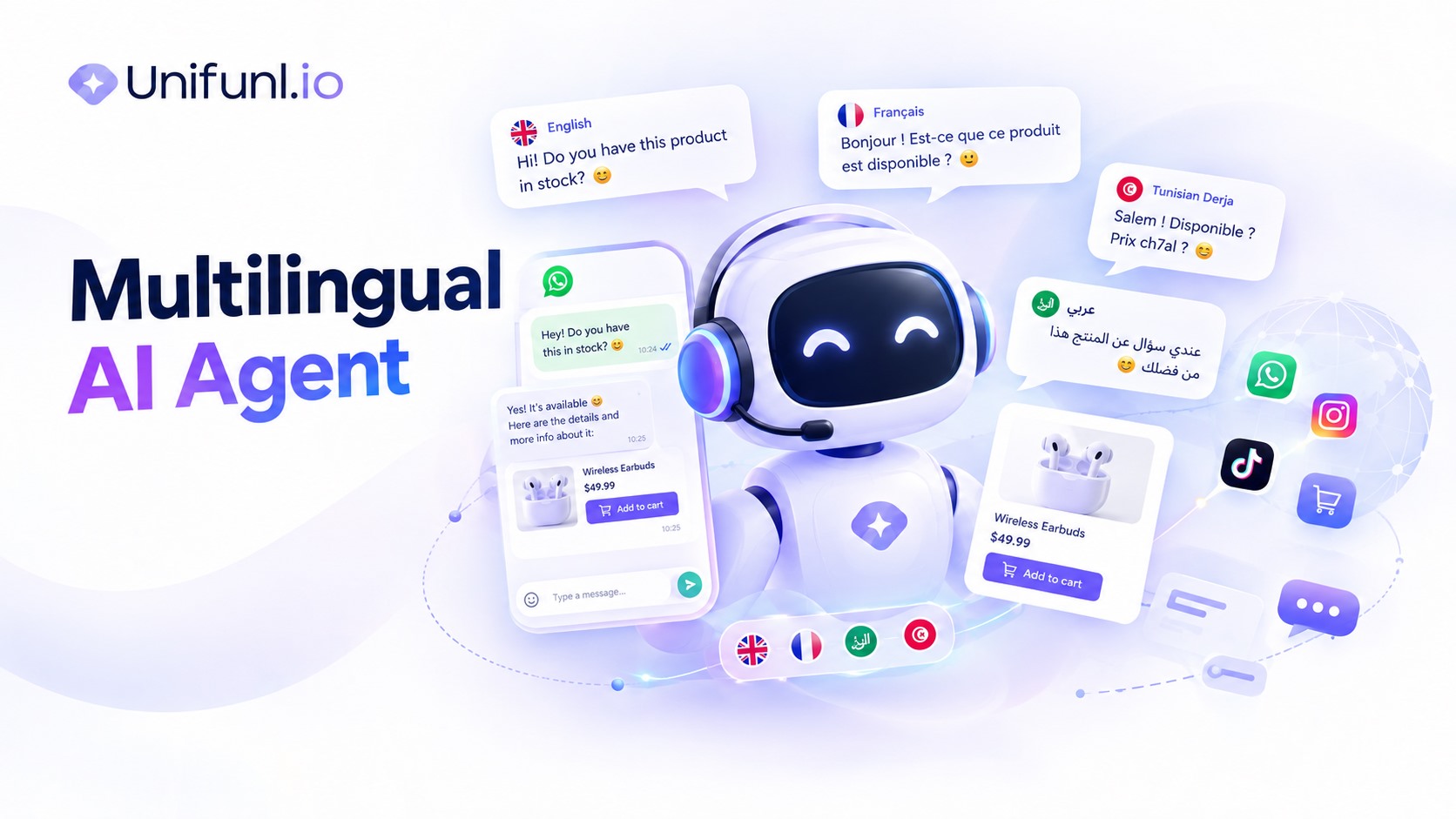
Unifunl’s AI agent replies in English, French, Arabic, Tunisian Derja, Moroccan, Algerian, Emirati, Omani and more, in Latin or Arabic script. It adapts to the language the customer uses, including when several are mixed in one message, which is how most people in the region actually write. Unifunl is one of very few platforms built to handle Tunisian Derja natively.
The languages you configure set the agent’s defaults, not its limits. If your agent is set up for Derja and a customer writes in English, French or Emirati Arabic, the agent answers in the language the customer used, so nobody gets turned away for writing the “wrong” language.
It understands inbound voice notes and images, not just typed text. A customer can send a voice message or a screenshot of a product and get a real answer, without anyone on your team having to listen, transcribe or translate first.
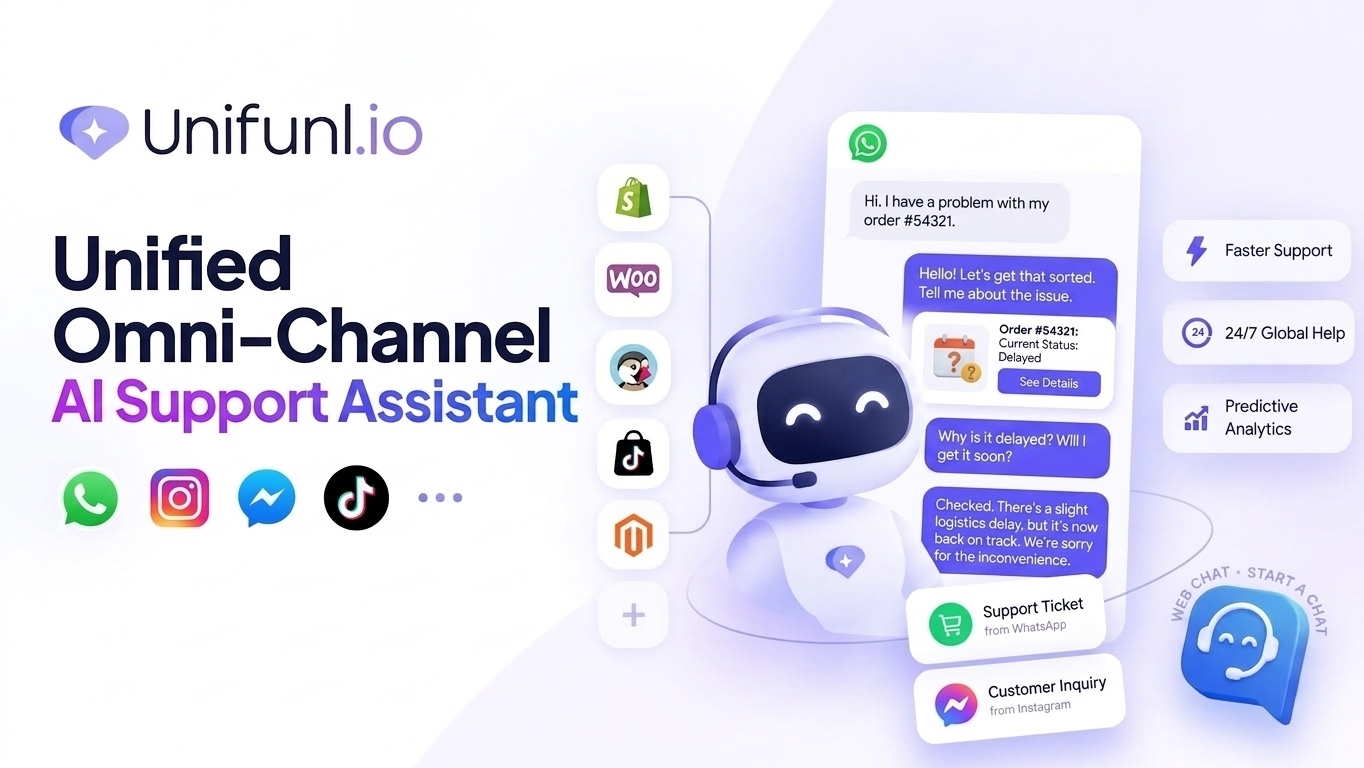
Language is only half of it. The agent answers from your synced store catalog, prices, variants and stock, so a correct answer in Derja is also a correct answer about your products. It runs on WhatsApp, Instagram, Facebook Messenger, TikTok and your website widget from one inbox.

How it works
How to set up a multilingual AI agent in about fifteen minutes
Connect your store
WooCommerce, Shopify, PrestaShop, Magento, Odoo, Salla, Converty or a custom store through the Unifunl Commerce API.
Connect your channels
WhatsApp, Instagram, Facebook Messenger, TikTok and the website widget, all feeding a single inbox.
Pick your languages
In the AI Center, set the agent’s main languages: English, French, Arabic, Tunisian Derja, Moroccan, Algerian, Emirati, Omani and more. Customers who write in another language still get an answer in theirs.
Choose a persona and tone
Start from a ready-made persona such as Amira, a brand ambassador fluent in Derja, or write your own, then set the tone.
Test it the way your customers write
In Live Test, send it Arabizi, a French–Derja mix or a voice note, exactly as a customer would, before it replies to anyone real.
Switch it on
Toggle Active, set your escalation rules, and invite the team for the conversations that need a human.
Capabilities and impact
What a multilingual AI agent changes in the business
01Derja and North African dialects
Tunisian Derja, Moroccan and Algerian, plus Gulf dialects such as Emirati and Omani, and more, alongside Arabic, understood and answered, not just detected.
Automation finally works for the market you actually sell to.
02Arabizi and Arabic script
Customers can write “9adech” or “قداش”. The agent reads both and replies in the script they use.
No customer has to switch keyboards to be understood.
03Mixed-language messages
Derja with French product names, English with Arabic greetings: the agent handles several languages in one message.
Fewer fallback replies, fewer conversations dumped on your team.
04Voice notes understood
Inbound voice notes are understood by the agent and answered like any text message, with no manual transcription step.
The customers who prefer to talk get served as fast as the ones who type.
Proof
Brands already selling in Derja, French and Arabic with an AI agent
These Unifunl customers run their front line in Tunisian Derja, French and Arabic, the way their customers actually write.
~20K
Conversations a month, in Derja
We’re finally talking to 20K customers a month without losing the brand voice.
Crêpes Factory
Crêpes Factory
Read the story40%
Conversion rate on DMs
We grew orders 30% and conversion is at 40%, with 70% less agents.
Brazilian Glow
Siwar — CS Director, Brazilian Glow
Read the story< 1 min
Response time, in Derja, French and Arabic
The AI now replies like a real product advisor in under a minute and converts 30–40% of DMs.
SF Nutrition
Operations, SF Nutrition
Read the storyWhy this and not a generic multilingual chatbot
Translation is not understanding
Most multilingual chatbots work by detecting a language and matching the message against scripted replies. That holds up for clean English or French. It breaks the moment a message is Derja in Latin letters, or three languages in one sentence, because there is no script for that.
Unifunl’s agent does not route by language. It reads the whole message, whatever mix it is written in, reasons over your catalog and policies, and answers in the customer’s own language. The same agent then takes the order, follows up and hands off, so multilingual is not a separate module bolted on top.
Generic multilingual chatbots
- Built for one clean language per message
- Arabic support means Modern Standard Arabic only
- Arabizi and dialects trigger fallback replies
- Voice notes ignored or forwarded to a human
Unifunl multilingual AI agent
- Handles several languages in one message
- Derja, Moroccan, Algerian, Emirati, Omani and more, alongside Arabic
- Answers in the customer’s language, whatever it is configured for
- Reads Latin and Arabic script alike
- Understands voice notes and images