وكيل الذكاء الاصطناعي










Unifunl vs Zendesk: AI Sales Agent or Support Platform?
It's 11pm. A customer messages your Instagram: "Do you have this in medium?"
With Zendesk, that message gets logged, routed, and tracked against a response target. By the time someone replies, it's tomorrow — and she's already bought it from whoever answered first.
With Unifunl, the agent checks your live stock, confirms the medium is available, and asks if she wants it in black or navy, At 11pm, without waking anyone up.
Same message. One system files it. The other sells from it.
Unifunl is an AI sales agent that answers from your catalog, creates the order in chat, and follows up if she goes quiet. Zendesk is a customer support platform for managing cases.
[get started]

What is Unifunl?
Unifunl is an AI sales agent for businesses that sell in DMs.
Use Unifunl when customers use your inbox to ask product questions, compare options, place orders, or request appointments. It is for businesses where conversations must produce commercial outcomes, not only resolve support requests.
Unifunl operates across WhatsApp Business Platform, Instagram, Facebook Messenger, TikTok DM, and a website chat widget. It works in English, French, Arabic, Tunisian Derja, Moroccan, and Algerian, including mixed-language messages written in Latin or Arabic script. Unifunl is one of very few platforms built to handle Tunisian Derja natively.
As an AI sales agent for ecommerce, the agent uses live catalog data to answer questions, send product images, create orders in chat, qualify service enquiries, book appointments, score contacts, and follow up when customers stop replying.
What is Zendesk?
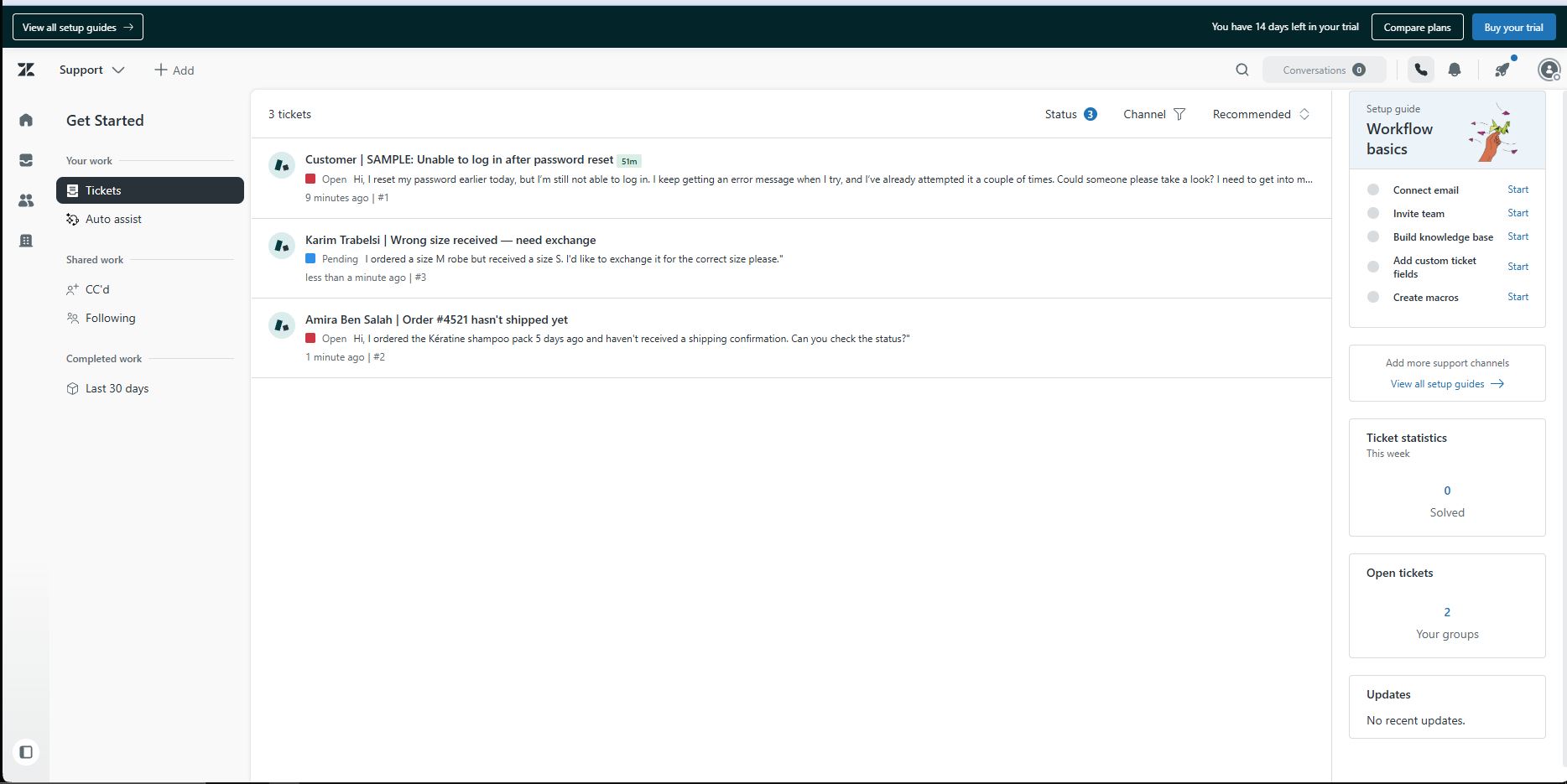
Zendesk is a customer service and support platform.
Use Zendesk when the main operational problem is organizing customer support requests, giving support teams a structured system for case management, and maintaining service workflows across customer touchpoints. Zendesk is an established support platform built around ticket handling and service operations, and the Zendesk chatbot and customer service AI agent layers sit on top of that same model.
The failure mode starts when a support request becomes a buying conversation. Resolving the case is no longer enough. Someone still needs to qualify intent, answer catalog questions, create the order or booking, and re-engage the customer when the conversation stops.
What is the difference between Unifunl and Zendesk?
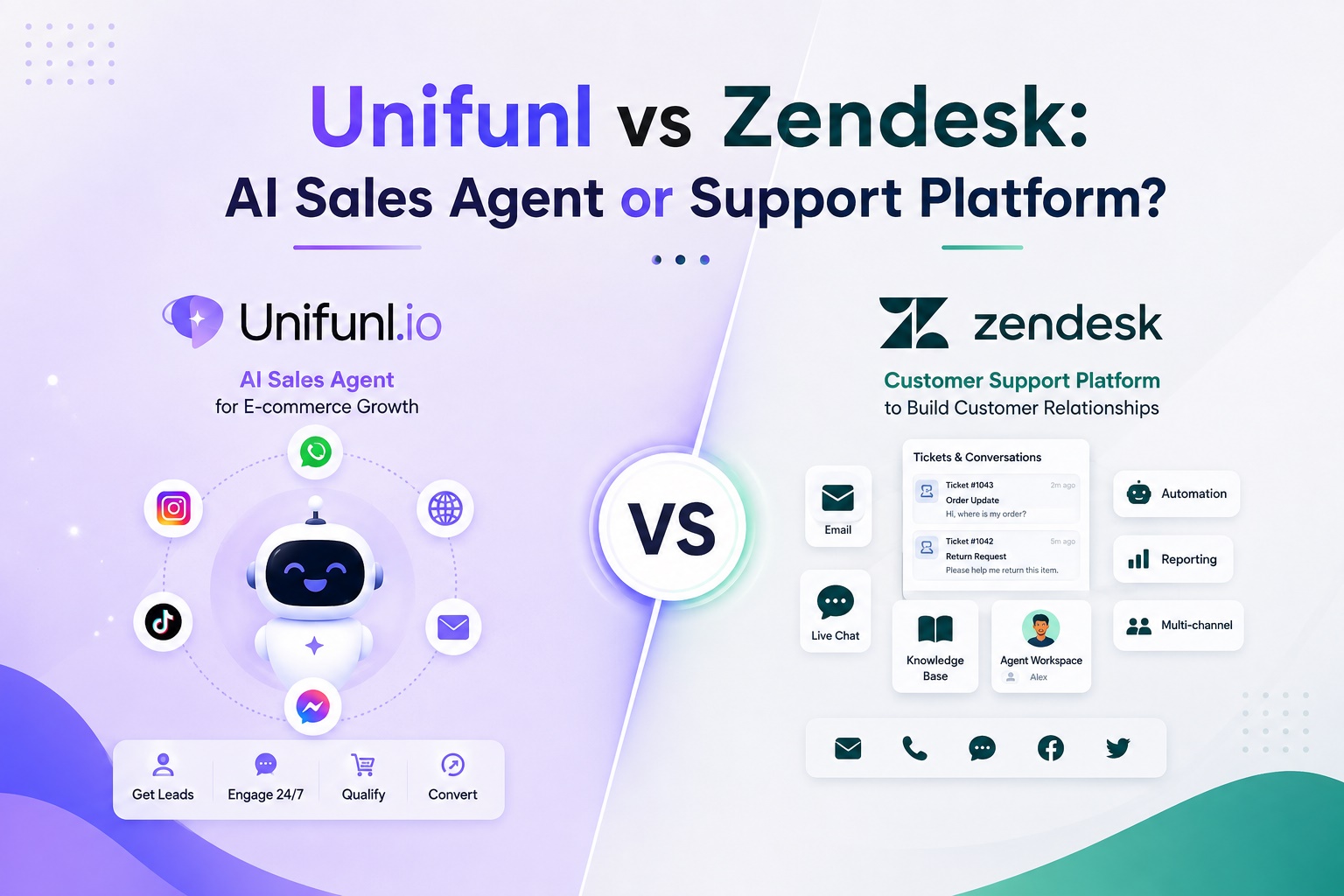
Unifunl is an AI sales agent for messaging-led commerce and services. Zendesk is a customer support platform. Unifunl runs sales conversations, while Zendesk helps support teams manage customer cases.
✅ Full support ➖ ❌ Not supported
| Area | Unifunl | Zendesk |
|---|---|---|
| Primary job | ||
| Core purpose | Sales conversations, orders, bookings, and follow-up | Customer support operations and case management |
| Operating model | An AI agent you brief to run messaging work | A support platform your team operates |
| Main commercial outcome | Moves conversations toward an order or appointment | Organizes and resolves customer requests |
| Conversation operations | ||
| Messaging channels | WhatsApp Business Platform, Instagram, Facebook Messenger, TikTok DM, website chat widget | Support channels and customer service workflows |
| Language handling | Six languages, including Tunisian Derja, Moroccan, and Algerian | Depends on team setup and configuration |
| Product questions | Uses synced products, prices, stock, and variants | Support-oriented customer assistance |
| Voice notes and images | Understands inbound voice notes and images | Support case context and ticket handling |
| Human involvement | Configurable escalation rules and a per-conversation autopilot toggle | Mature support teams, routing and service workflows |
| Commerce and services | ||
| Orders in conversation | Creates orders in chat and syncs them to the merchant store | Support operations remain the primary design focus |
| Service enquiries | Qualifies leads and books appointments | Customer service processes remain the primary design focus |
| Contact progression | New, Warm, Hot, Converted and Customer | Support case progression and service workflows |
| Follow-up measurement | Attributes revenue from follow-ups within a 7-day window | Support reporting and operational analysis |
| Setup and commercial model | ||
| Store connections | WooCommerce, Shopify, PrestaShop, Magento, Odoo, Salla, Converty, and custom stores via the Unifunl Commerce API | Configuration depends on the selected setup |
| Configuration | Natural-language configuration with confirmation before changes apply | Support process configuration managed within the platform |
Swipe horizontally to see the full table →
What does Unifunl show you that a support inbox does not?
A support inbox treats every conversation as identical work: one ticket, one queue, one resolution. Unifunl instead separates Leads by how close they are to buying, then reports on that progression.
In the Leads CRM, every lead sits in a stage: New, Warm, Hot, Converted, or Customer. The first four are set automatically based on conversation behavior. So instead of a pile of open tickets, you see how many people are still browsing, how many are close to converting, and how many have actually bought.

Alongside the pipeline, you get the numbers that explain it:
- Leads by channel, so you can see whether WhatsApp, Instagram, Messenger, or the website widget is producing the pipeline.
- Conversion rate, measured on how many contacts complete the workflow and actually buy, rather than on tickets closed.
Put that next to your acquisition spend and you can reason about what an order costs you, by channel, rather than treating every support conversation as the same operational unit.
When does Unifunl fit better than Zendesk?
Five real jobs, and what happens once a buyer is actually talking to you.
Fashion boutique: late-night Instagram questions about sizes, colours, variants and stock
Unifunl — Answers from the live catalog, sends product images, and creates the order while purchase intent is still active.
Zendesk — Helps a support team organize incoming requests, but the purchase intent goes unanswered until the team is back.
Electronics retailer: high-volume WhatsApp stock enquiries
Unifunl — Uses synced stock, prices, and variants to guide the conversation toward the right product and create an order in the connected store.
Zendesk — A support workflow documents the enquiry. Repeated availability questions remain unconverted enquiries.
Beauty retailer: customers who stop replying before checkout
Unifunl — Scores the contact and follows up automatically after a configurable silence window, with anti-spam guardrails.
Zendesk — Keeps the service interaction organized. A resolved case is not re-opened to chase the order that never happened.
Academy: enrolment enquiries that need qualification and booking
Unifunl — Services mode qualifies the prospect and books an appointment, with escalation to a person when required.
Zendesk — Helps staff manage enquiries. Qualifying the prospect before a staff member can act still has to happen somewhere.
Food retailer: order details scattered across DM threads
Unifunl — Creates the order in chat and syncs it to the connected store.
Zendesk — Supports the service process around these conversations, but a message record alone does not create an order.
None of this makes Zendesk weak software. For a support operation at scale, its case management and service workflows are more mature than anything a sales agent needs. It is just not built to close the sale.
Unifunl pricing vs Zendesk pricing: what does each platform cost to run?
Unifunl
- AI Sales Agent: answers product questions from live catalog data, qualifies buyers, and creates the order inside the conversation.
- Omnichannel messaging: one agent across WhatsApp, Instagram, Facebook Messenger, TikTok DM, and a website widget, with no separate charge per conversation channel or human seat.
- Six languages, including Tunisian Derja, Moroccan, and Algerian, in Latin or Arabic script.
- Follow-up and attribution: configurable silence-window follow-up with anti-spam guardrails, contact scoring from New to Customer, and revenue attributed to those follow-ups.
- Store connections: WooCommerce, Shopify, PrestaShop, Magento, Odoo, Salla, Converty, and custom stores through the Unifunl Commerce API.
Zendesk
- A mature support platform with case management, routing, and service reporting.
- Priced by tier, seats, and selected service requirements, so cost scales with the size of the support team rather than with commercial outcomes.
- No catalog-grounded selling, in-chat order creation, or follow-up revenue attribution. That is not the job it was built to do.
- Plan structure varies, so check current Zendesk terms for what applies to your support operation.
The operational comparison is not limited to subscription cost. Compare what each system is expected to do: one organizes the request, the other is meant to close it, across every inbox where questions, orders, qualification, and follow-up currently land on staff.
Can Unifunl and Zendesk work together?
Yes. The systems can run separate workflows when a business needs both sales conversations and structured support processes.
Zendesk
Runs the support operation
- Case management, routing and service workflows
- Structured handling of help requests at scale
- Support reporting and operational analysis
Unifunl
Runs the sales floor
- Answers product, stock and variant questions from the live catalog
- Creates the order in chat and syncs it to your store
- Follows up on quiet buyers and attributes the revenue
The handoff: Product guidance, order creation, qualification and follow-up stay in the sales workflow. Human support resolution moves into the support workflow.
Unifunl escalates conversations to a human through configurable rules. Your team can then route that support work through its established service process, subject to your technical implementation.
Frequently asked questions
What happens to the next "do you have this in medium?"
That message is coming again tonight, tomorrow, every day this runs. Zendesk will file it. Unifunl will try to sell it — checking stock, confirming the order, following up if she goes quiet.
Keep Zendesk for the questions that actually need a human. Point the sales conversations at Unifunl.
Connect a channel, upload your catalog, and it's live in under 24 hours. No code, no card.